

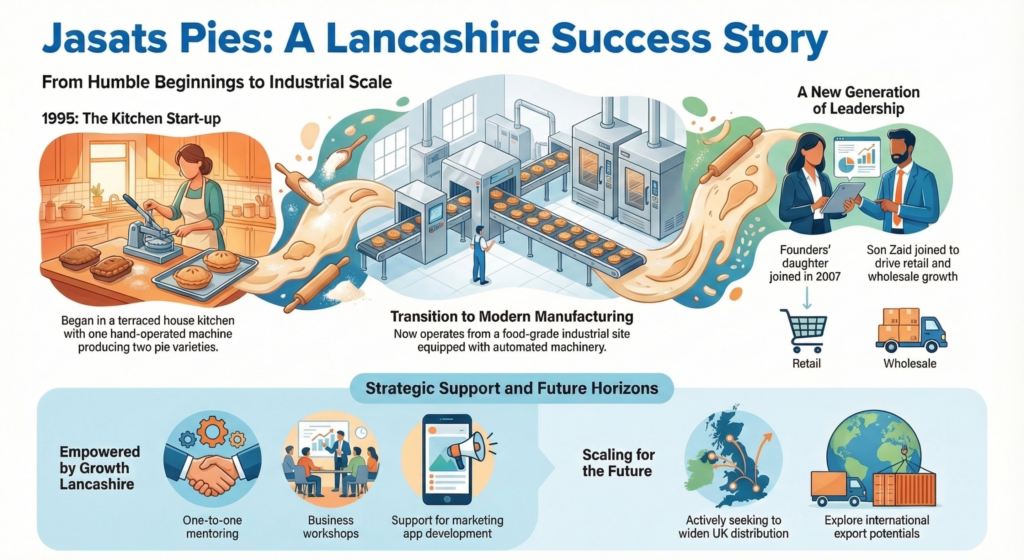
In 1995, the air in a quiet terraced house in Blackburn, Lancashire, smelled of spices and pastry. There was no gleaming stainless steel, no automated conveyor belts, and no logistics department. Instead, there was a husband, a wife, and a single, hand-operated machine. This is where Jasats began—not with a venture capital injection, but with a “relatable curiosity” about whether honest, home-cooked food could find a place at the heart of the community.
Today, that domestic kitchen has been replaced by a high-output, food-grade industrial site. The Jasats story is a masterclass in how a family brand scales from a household venture into a regional powerhouse. As a growth strategist, I see more than just a success story here; I see a repeatable blueprint for scaling heritage brands without losing their soul.
1. The “Single Machine” Phase: Lean Origins as a Strategic Advantage
In the beginning, the Jasats operation was the definition of “lean.” By producing only two varieties of pies using one manual machine, the founders avoided the “complexity trap” that sinks many startups. They didn’t worry about mass distribution; they worried about the “clank” of the manual press and the perfect flake of the crust.
Starting small wasn’t a limitation—it was a strategic advantage. It allowed for low overhead and incredibly tight feedback loops. They mastered the quality of those two core products before ever entertaining the idea of expansion. This phase established the “hearty, flavour-rich” benchmark that would eventually anchor their industrial-scale operations.
“To craft hearty, flavour-rich savoury bakes that bring people together.”
2. The Second-Generation Catalyst: Tradition Meets Innovation
The most dangerous moment for a family business is the transition between generations. Many fail to modernize, clinging to “how we’ve always done it” until they become obsolete. Jasats took the opposite path. When the founders’ daughter joined in 2007, she brought a surge of “fresh ideas and energy.” Later, when their son Zaid “joined the cavalry,” the business shifted from a local operation to a modern enterprise.
Zaid’s leadership serves as a case study in operational modernization. He didn’t just maintain the status quo; he hardened the B2B pipeline and took over the day-to-day complexities of production and logistics. By driving the brand into retail sectors and direct-to-consumer sales, he proved that tradition is not a museum piece—it is a foundation upon which you build modern, scalable systems.
3. Growth is Never a Solo Act: The Power of External Expertise
Even after years of established success, the Jasats family maintained a “growth mindset” that prioritized outside perspective. Scaling a business requires a level of specialized knowledge that the “family unit” alone rarely possesses.
Through a long-term relationship with Growth Lancashire and advisor Purves Ali, Jasats accessed high-impact mentoring and strategic workshops. Perhaps the most significant pivot was the development of a marketing app—a sophisticated digital tool for a traditional food manufacturer. This bridge between “traditional bakes” and “modern digital engagement” allowed them to diversify their offerings, moving beyond simple pies to include pasties, samosas, and ready meals. Recognizing that external support isn’t a sign of weakness, but a catalyst for professionalization, is what separates a lifestyle business from an industrial leader.
4. The Innovation-Tradition Balance: Automating the Heritage
The transition to a food-grade industrial site equipped with automated machinery is where most brands lose their “handmade” essence. The strategist’s challenge is to ensure that automation serves consistency rather than just volume.
Jasats has managed this by ensuring their technology is an extension of their Lancashire roots. The machinery might be faster, and the team of skilled staff might be larger, but the objective remains the same: a pie or samosa produced at scale must taste exactly like the one produced in that 1995 kitchen. By rooting their technical expansion in their family heritage, they’ve achieved “consistency at scale”—the holy grail of food manufacturing.
“Honest, flavour-packed bakes that celebrate our Lancashire roots and family heritage.”
Conclusion: The Next Chapter of the Lancashire Story
Jasats is no longer just a Blackburn secret; it is a brand poised for a national stage. Their roadmap for the future—focusing on sustainable growth, exploring export potentials, and strengthening their presence across the UK—is fuelled by a team that blends family legacy with fresh, corporate-level ideas.
The Jasats journey reminds us that scaling is not merely about adding machines; it is about evolving the family ethos through a combination of grit, external expertise, and the courage to innovate.
Reflecting on your own professional or creative endeavors: How are you balancing the preservation of your core traditions with the necessary innovations required for your next phase of growth?
