

1. The Hook – From Retirement to Rapid Growth
Scaling a business is rarely a linear trajectory; it is more often a “rocky road” paved with hard-won transitions. For Mike, a co-founder who had already retired once before returning to launch a care business with his daughter, Emily, the journey has been a masterclass in the friction of growth.
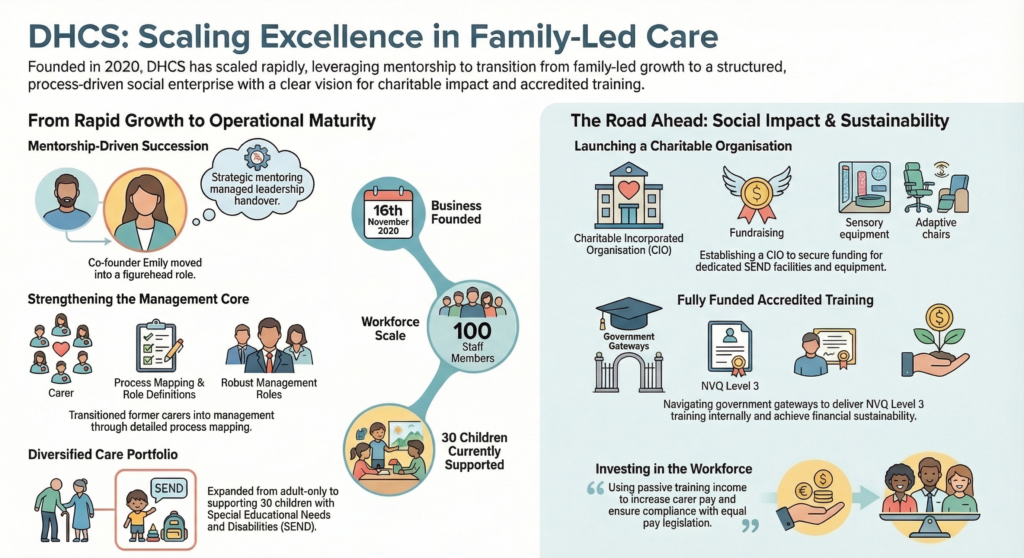
Since registration in late 2020, the company surged to nearly 100 staff. But by 2024, the business reached a plateau—what Mike calls “jogging along.” Growth brought a heavy psychological burden: the founders were pinned to the daily operations, unable to see the machine for the parts. The pressure was so intense that Emily reached a breaking point where she considered leaving the business entirely. To save both the founder and the company, they had to pivot from being the primary “workers” to becoming the figureheads of an organisation that could finally breathe in their absence.
After many meetings with Growth Lancashire Advisor Andy Hall, who supported them on different legal formations for a business, who supported them with looking at other towns in Lancashire to possibly work from, who supported them by providing a mentor to enable them to pivot and help develop leadership skills, particularly in managing and empowering staff without micromanaging.
2. Takeaway 1 – The “Forced Delegation” Sabbatical
One of the most counter-intuitive growth moves Mike and Emily implemented was born from necessity: Emily’s upcoming sabbatical. Rather than viewing her absence as a risk, Mike is utilising this break as a strategic tool for “forced delegation.”
By preparing for Emily to be away for the summer, the business has been forced to “absorb” her day-to-day responsibilities into the existing team. This isn’t a temporary patch; it is a permanent restructuring of how authority flows through the company. This strategic absence ensures that when Emily returns, she won’t be sucked back into the tactical weeds. Instead, she will step into a refined role that allows her to lead from the top.
“She’ll already be a figurehead rather than… a worker.” — Mike
3. Takeaway 2 – The Loyalty Gamble—Promoting from Within
In the search for management talent, many high-growth firms hunt for “blue-chip” outsiders. Mike took a different, more difficult path: every person currently in a management position within the team started as a carer.
Coming from a corporate background himself, Mike admits that hiring experienced managers might have made for a “less rocky road.” However, he intentionally chose to prioritise loyalty over a resume. The trade-off is significant; it requires the founder to “plug the gap” personally, providing the mentoring and support these new leaders need while they learn the ropes. This builds a culture of trust and internal mobility that an outside hire simply cannot buy.
Key Insight – The Founder as a Bridge Promoting from within requires the founder to act as a temporary operational bridge. You must be willing to “plug the gap” between a staff member’s current ability and their future potential, investing your own time to build a culture of commitment that external hires rarely replicate.
4. Takeaway 3 – Granularity as a Growth Engine
After the business spent two years “jogging along” at a plateau, the catalyst for change arrived through an external mentor, Julie. Mike credits her with “turning the lights on,” leading him to a deep dive into “granularity”—a process of mapping every internal cog of the machine.
By creating a comprehensive system that defines every process, audit, and CRM data flow, Mike has transitioned the business from a collection of tasks into a defined system. Every staff member now has a set of reports and audits to run, ensuring errors are caught and ownership is clear.
“I think that’s something that’s been a long time coming, but we’ve never had the time to actually do it. I feel like I’ve been forced to make the time to do it now… there is something satisfying about seeing it completed.” — Mike
5. Takeaway 4: The “Charity Pivot” for Specialised Impact
As the business expands into Special Educational Needs and Disabilities (SEND) care—a deep passion for Emily, whose own son is on the autistic spectrum—the leadership has recognised the limitations of a private business model. Their ambition is to “splinter off” the SEND group into a registered Charitable Incorporated Organisation (CIO).
The logic is a strategic hybrid of impact and infrastructure:
- Access to New Funding: Private companies are locked out of critical funding pools, such as the National Lottery or corporate grants from retailers like Tesco.
- Dedicated Infrastructure: Funding allows for the purchase of specialised equipment and a dedicated full-time space, moving away from the limitations of rented community centres.
- Reputational Kudos: Operating as a registered charity provides a layer of brand authority and trust that is vital in the specialised care sector.
6. Takeaway 5 – Turning Mandatory Costs into a Regulatory Shield
Currently, the business delivers mandatory care training at a loss—a necessary but expensive burden. Mike is now navigating the “government funding maze” to pivot this cost centre into a fully funded, accredited training centre.
By becoming a gateway for government funding, the business can reclaim the costs of trainers, rooms, and qualifications up to NVQ Level 3. This creates a “Virtuous Wheel”: the training centre generates income, which is then used to pay carers for their learning time. In a sector under constant pressure from equal pay and minimum wage legislation, this is a vital regulatory shield. It ensures the business stays ahead of compliance by turning unpaid training time into a funded, professionalised activity.
7. Conclusion – The Long Game of Succession
The next 6 to 12 months for Mike and Emily are about achieving stability through systems. By mapping processes, forcing delegation through a sabbatical, and diversifying through a charitable arm, they are building more than just a care company; they are building a legacy that can survive the founders. The support offered by Growth Lancashire through experienced advisor Andy Hall, through mentoring and through relevant workshops, will enable this business to thrive.
The transition from a “worker” mindset to a “figurehead” mindset is the hardest shift a founder can make. However, it is the only way to ensure the machine keeps running when the founder finally decides to retire—for the second, and final, time.